System and Method for Optimizing Digital Assets | Eikona
Our latent-space optimization method is now a published patent application
Eikona Technologies — Tech Blog
Last week the USPTO published our patent application "System and Method for Optimizing Digital Assets" (US 2026/0261745 A1, inventors Omer Hacohen and Nir Weingarten). It covers the core idea behind how Eikona turns real user feedback into better creative — automatically, and without a human guessing what to change next.
You can read the full filing on the USPTO's Patent Public Search: https://ppubs.uspto.gov/pubwebapp/ (search for publication number 20260261745).
Here's a short tour of what's in it.
The problem: A/B testing is a human-in-the-loop guessing game
Every growth team knows the drill. You want a hero image, an email, or a landing-page layout that maximizes some KPI — scroll depth, click-through, conversions. So you make a few variants, run an A/B test, pick the winner, and then someone sits down and tries to explain why it won ("the red background worked") in order to design the next round.
Two things make this hard:
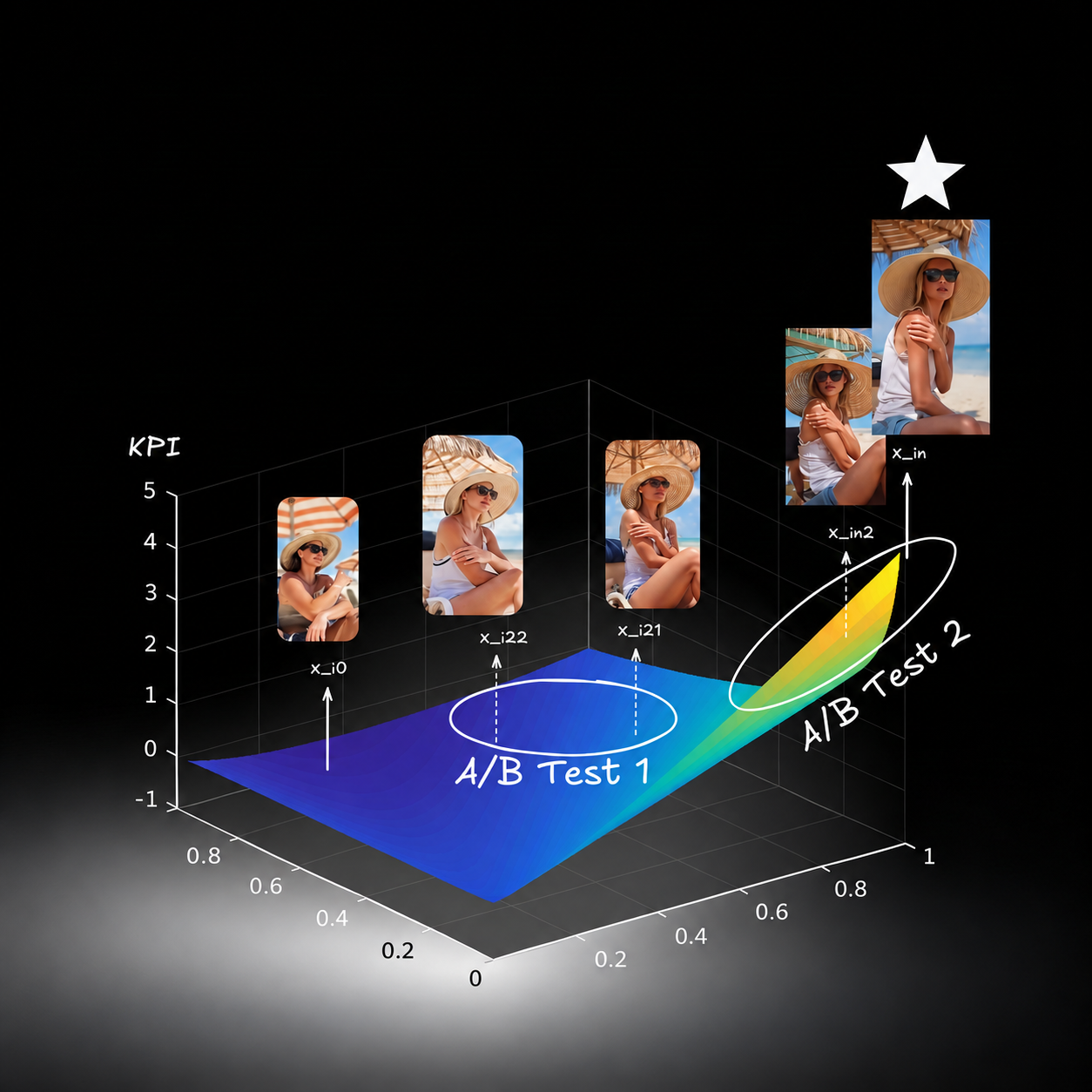
- The changes aren't controllable. With prompt-driven generative models, a small edit to the prompt can produce a completely different image. You can't dial in "a little bit different" — and there are infinitely many images between two prompts that no prompt will ever reach (Figs. 1A–1D in the filing show this).
- The reason a variant wins is rarely simple. Reducing it to a one-line insight introduces human bias and usually throws away most of the signal the test actually produced.
The result is a black-box optimization problem — no differentiable mapping from "media" to "KPI" — that people have been solving by intuition.
The idea: let the audience be the reward signal
The method in the filing replaces the human guess with a closed loop driven by real user feedback. Structurally it looks a lot like reinforcement learning from human feedback, except the "humans" are your actual audience and the reward is the KPI you already measure:
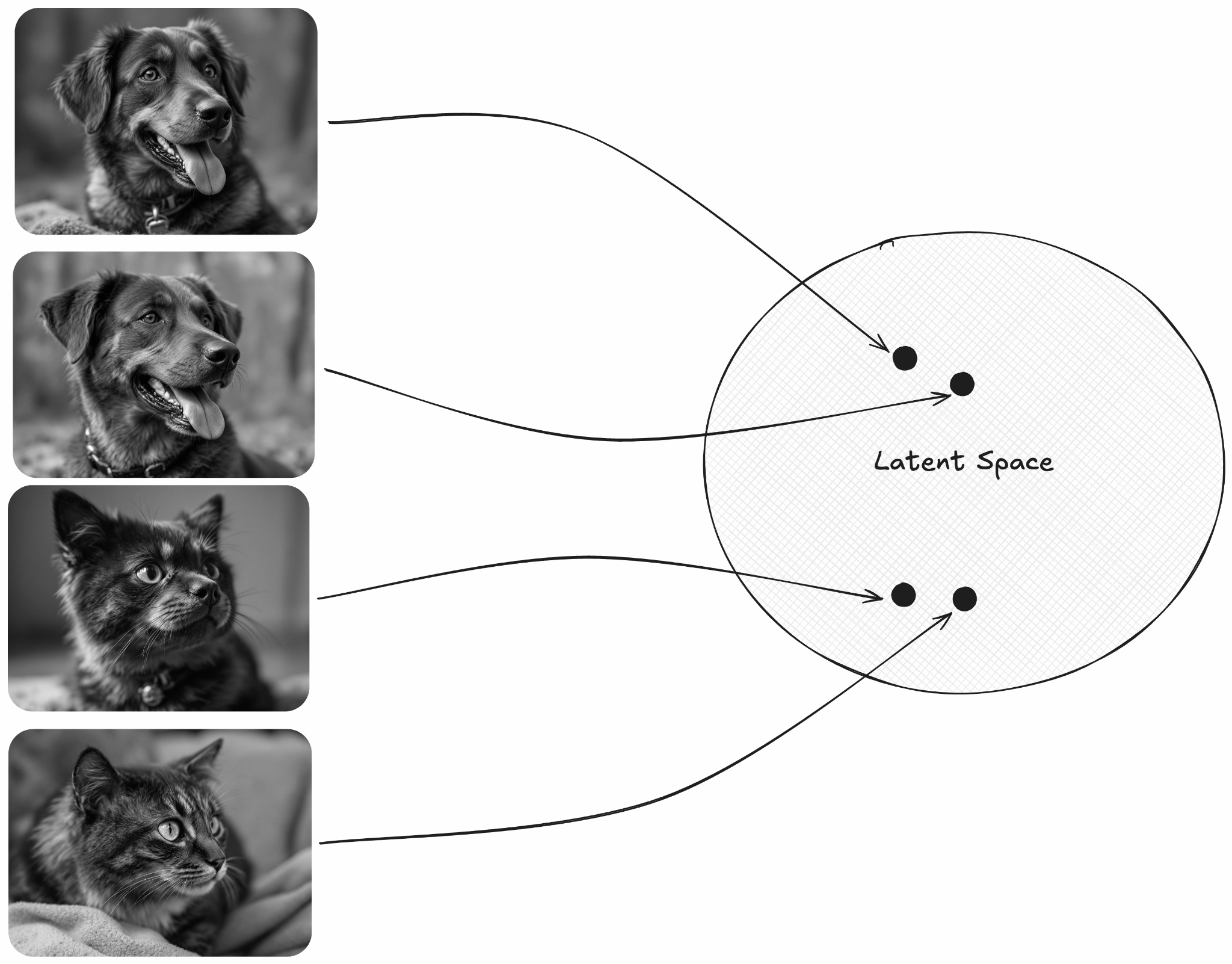
- Policy / search space: the latent space of a pre-trained generative model (image, text, video, audio, or layout).
- Actions: small, bounded moves in that latent space.
- Reward: measured KPI from an A/B test on real users.
- Update: the best-performing variant becomes the starting point for the next round, and the results steer where the next exploration goes.
No reward model has to be trained up front, and nobody has to articulate what "better" looks like. The audience does that directly.
How it works
The key property we lean on is smoothness of the latent space: a small step in latent coordinates yields a small, controlled change in the generated asset — and, by extension, a small change in the KPI it induces. That is what turns an intractable search over "all possible images" into a tractable trajectory search.
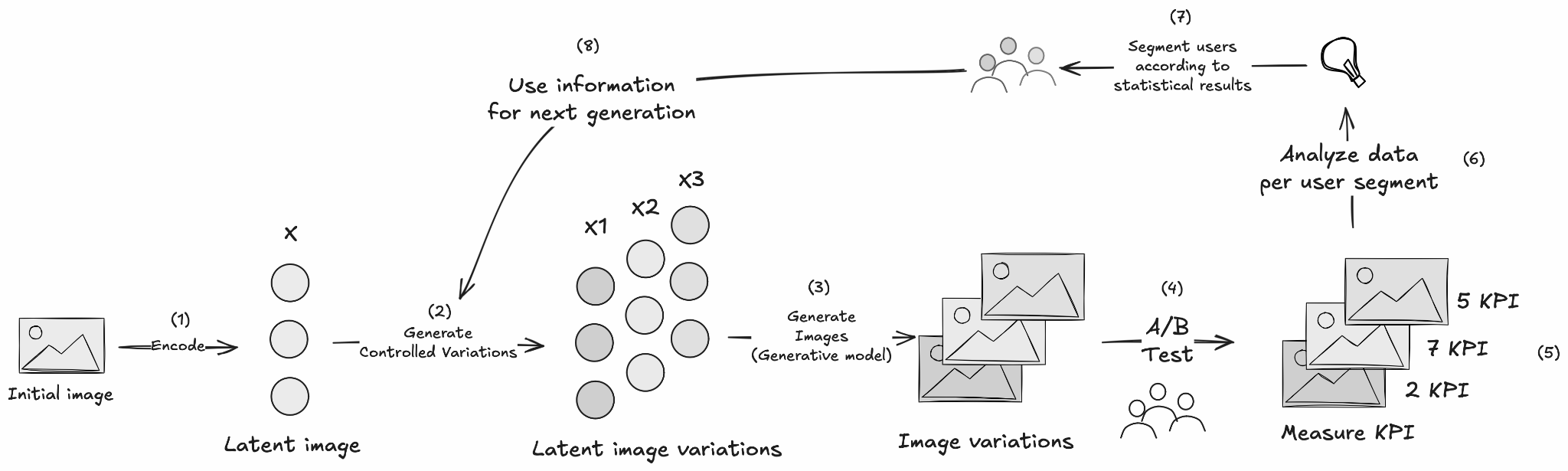
Each iteration:
- Encode the current asset into a latent vector
x. - Generate controlled variations
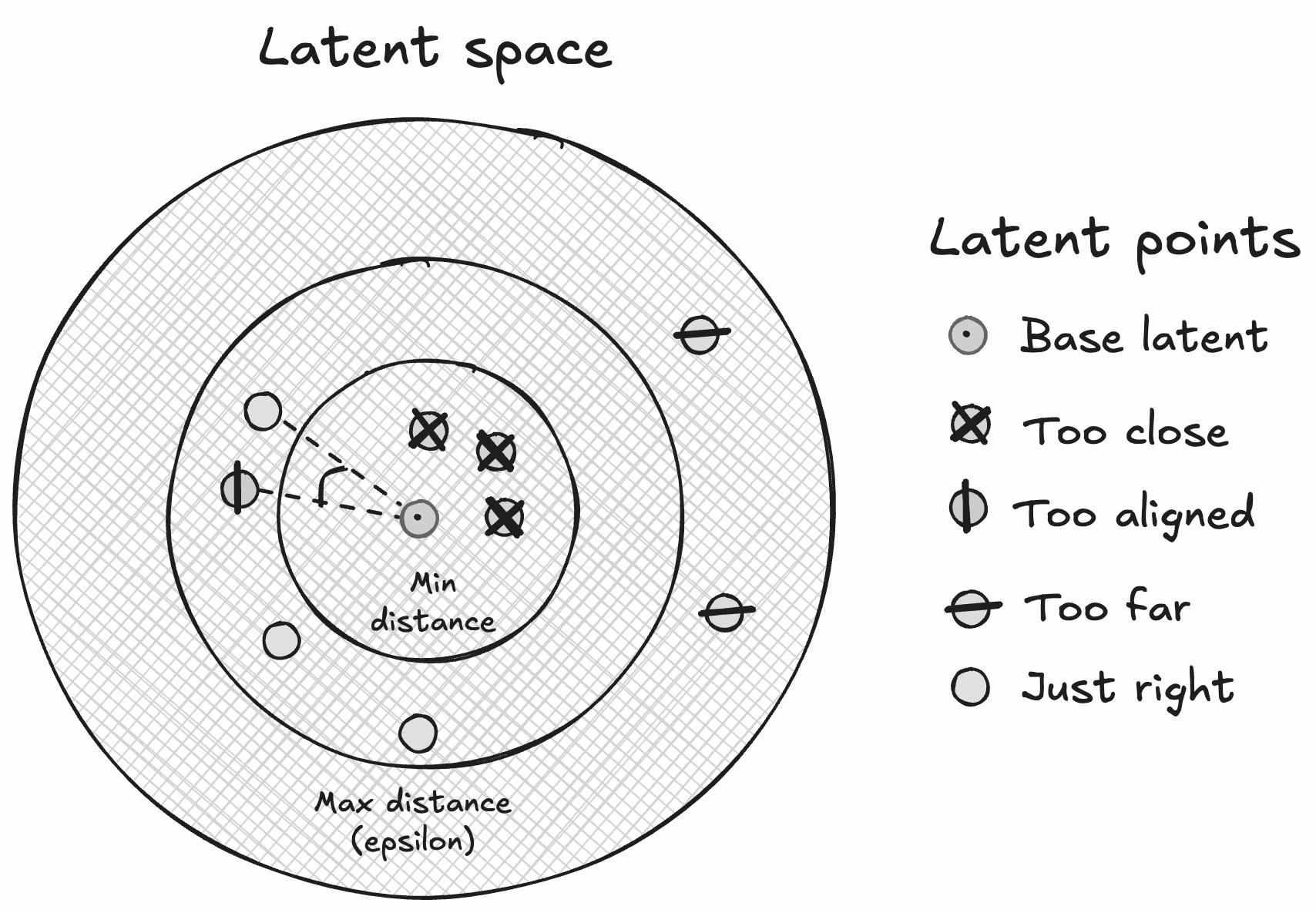
x1, x2, x3…— each within a maximum distance ε ofx, along chosen exploration directions. - Decode them back into real assets with the generative model.
- A/B test the assets on live users and measure the KPI. Traffic can be allocated with a multi-armed bandit, so weak variants stop costing conversions quickly.
- Select the best variant. If the exit criterion isn't met (no further improvement, or a KPI threshold reached), it becomes the seed for the next iteration.
- Feed the results back to condition how the next variations are generated.
A few details worth calling out:
- Explore vs. exploit. The distance ε and the orthogonality of the exploration directions are tunable knobs. Larger, more diverse steps explore; smaller steps aligned with a previously successful direction exploit. Standard tools like ε-greedy or Thompson sampling apply.
- Direction selection can be random (simulated-annealing style), evolutionary, or learned — a model trained on past user interactions to predict which latent directions are likely to move the KPI.
- Asset constraints. Some things must not change: the product, the logo, the legal copy. The filing describes preserving designated regions or semantics (e.g., via masked/differential diffusion) while everything else is free to vary.
- Segmentation. If a statistically distinct user cluster prefers a different variant, the search forks and each segment gets its own trajectory — personalization falls out of the same loop.
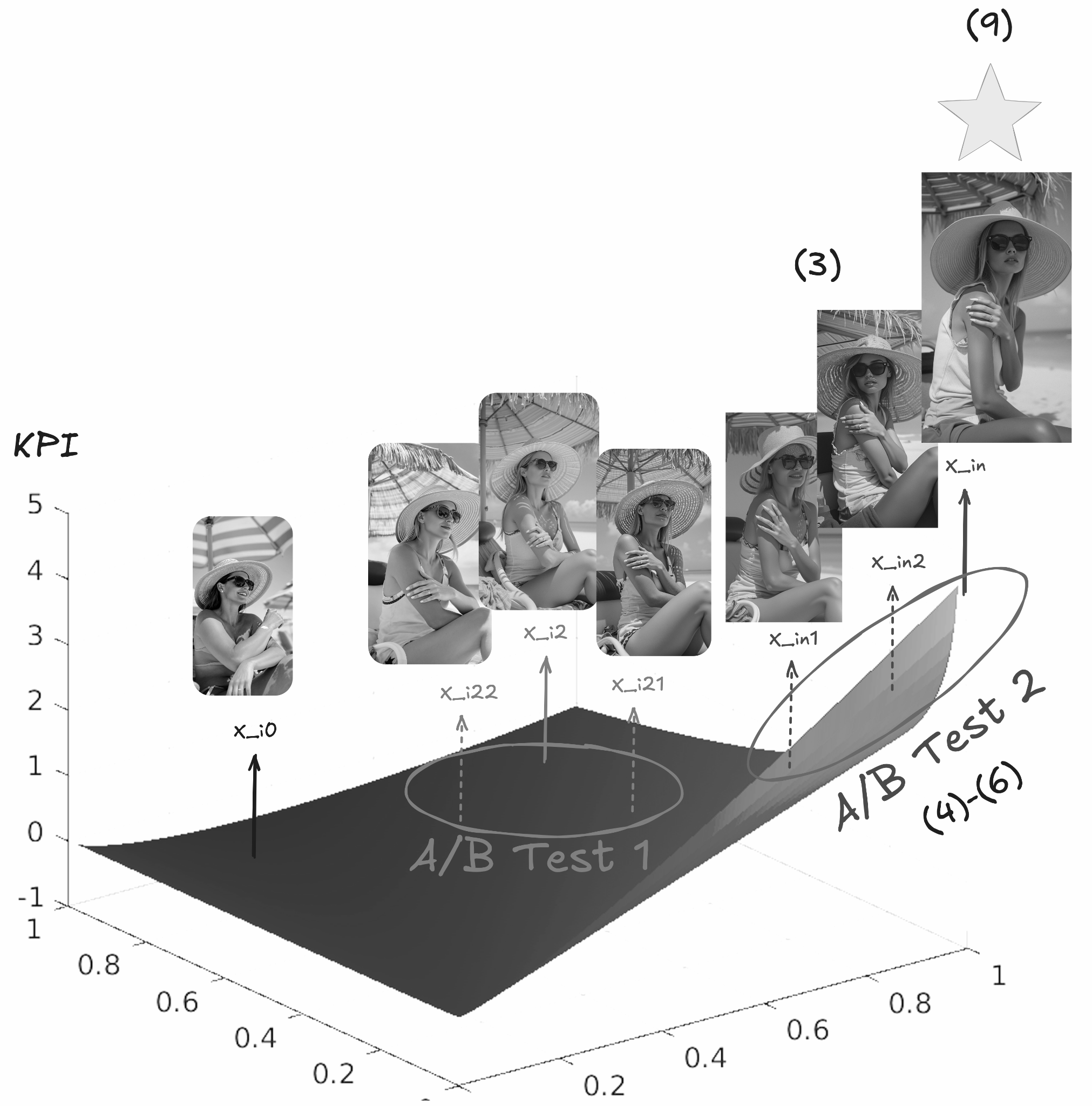
The power of guided steps on the latent space
Existing content-optimization tooling either picks from a fixed pool of assets or generates new ones from a loose, human-mediated reading of past tests. Neither closes the loop. Optimizing directly in the latent space of a generative model — with your real audience as the reward — gives you a search that is controllable, automatic, and grounded in measured behavior rather than intuition.
It's also media-agnostic: the same loop works for images, copy, video, audio, and page layouts, and for any KPI you can measure.
Read the filing
- Publication: US 2026/0261745 A1, published September 3, 2026
- Application: 19/543,034, filed February 18, 2026 (priority to a February 2025 provisional)
- Where: USPTO Patent Public Search — search
20260261745
If you're working on creative optimization, generative model steering, or experimentation platforms and want to compare notes, we'd love to hear from you.